
》》LET'S CLARIFY SOME MISINFORMATION ABOUT AGE PROGRESSION OF MISSING MINORS OVER TIME.
In recent years, for our official Age Progressions for Denise 2021 - 2025, after the R.I.S., we have relied on a professional who has been collaborating for years with the NCMEC, Paloma Joana Galzi, Forensic Imaging Specialist.
◇◇◇
》》The NCMEC (The National Center for Missing & Exploited Children) collaborates with families, victims, law enforcement, etc. to help prevent child abductions, find missing children, and provide services aimed at countering and combating child sexual exploitation.
The forensic artists at NCMEC have created over 7,500 age progression reconstructions of long-term missing children, said Colin McNally, supervisor of the Forensic Imaging Unit. So far, 1,800 children who underwent age progression reconstruction have been found, some thanks to this process.
McNally's team of forensic artists digitally updates the photo of a missing child on the computer every two years, until the age of 18, and then every five years, as facial features change less after adulthood.
Our case managers work with families and collect photos of the missing child's biological parents and siblings, preferably taken when they were the same age the child would be today. The artists then create the age progression reconstructions, or "AP" (age progressions), blending the features present in these reference photos with the knowledge acquired about the evolution and aging of children's faces over time—a process that takes about eight hours for each reconstruction.
Source: www.missingkids.org
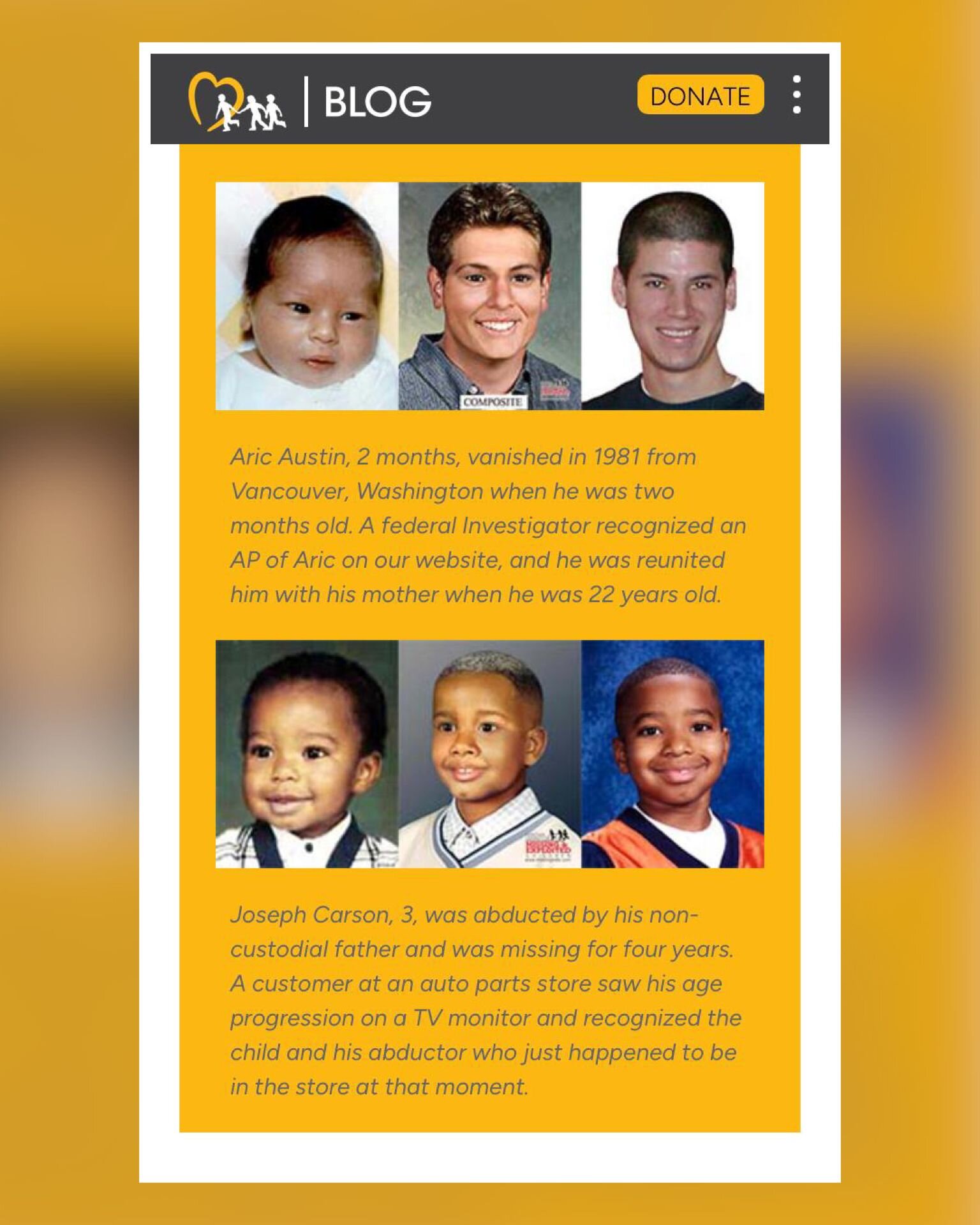
Below, we show you three examples of missing minors who were later found. As you can see from the images, on the left is the PHOTO of the child at the time of disappearance, the Age Progression (what they might look like), and on the right once they were found.
#missing #MissingChildren #world #Europe #Italy #missing #ageprogression



In recent years, for our official Age Progressions for Denise 2021 - 2025, after the R.I.S., we have relied on a professional who has been collaborating for years with the NCMEC, Paloma Joana Galzi, Forensic Imaging Specialist. ◇◇◇ 》》The NCMEC (The National Center for Missing & Exploited Children) collaborates with families, victims, law enforcement, etc. to help prevent child abductions, find missing children, and provide services aimed at countering and combating child sexual exploitation. The forensic artists at NCMEC have created over 7,500 age progression reconstructions of long-term missing children, said Colin McNally, supervisor of the Forensic Imaging Unit. So far, 1,800 children who underwent age progression reconstruction have been found, some thanks to this process. McNally's team of forensic artists digitally updates the photo of a missing child on the computer every two years, until the age of 18, and then every five years, as facial features change less after adulthood. Our case managers work with families and collect photos of the missing child's biological parents and siblings, preferably taken when they were the same age the child would be today. The artists then create the age progression reconstructions, or "AP" (age progressions), blending the features present in these reference photos with the knowledge acquired about the evolution and aging of children's faces over time—a process that takes about eight hours for each reconstruction. Source: Below, we show you three examples of missing minors who were later found. As you can see from the images, on the left is the PHOTO of the child at the time of disappearance, the Age Progression (what they might look like), and on the right once they were found. #missing #MissingChildren #world #Europe #Italy #missing #ageprogression
In recent years, for our official Age Progressions for Denise 2021 - 2025, after the R.I.S., we have relied on a professional who has been collaborating for years with the NCMEC, Paloma Joana Galzi, Forensic Imaging Specialist. ◇◇◇ 》》The NCMEC (The National Center for Missing & Exploited Children) collaborates with families, victims, law enforcement, etc. to help prevent child abductions, find missing children, and provide services aimed at countering and combating child sexual exploitation. The forensic artists at NCMEC have created over 7,500 age progression reconstructions of long-term missing children, said Colin McNally, supervisor of the Forensic Imaging Unit. So far, 1,800 children who underwent age progression reconstruction have been found, some thanks to this process. McNally's team of forensic artists digitally updates the photo of a missing child on the computer every two years, until the age of 18, and then every five years, as facial features change less after adulthood. Our case managers work with families and collect photos of the missing child's biological parents and siblings, preferably taken when they were the same age the child would be today. The artists then create the age progression reconstructions, or "AP" (age progressions), blending the features present in these reference photos with the knowledge acquired about the evolution and aging of children's faces over time—a process that takes about eight hours for each reconstruction. Source: Below, we show you three examples of missing minors who were later found. As you can see from the images, on the left is the PHOTO of the child at the time of disappearance, the Age Progression (what they might look like), and on the right once they were found. #missing #MissingChildren #world #Europe #Italy #missing #ageprogression
In recent years, for our official Age Progressions for Denise 2021 - 2025, after the R.I.S., we have relied on a professional who has been collaborating for years with the NCMEC, Paloma Joana Galzi, Forensic Imaging Specialist. ◇◇◇ 》》The NCMEC (The National Center for Missing & Exploited Children) collaborates with families, victims, law enforcement, etc. to help prevent child abductions, find missing children, and provide services aimed at countering and combating child sexual exploitation. The forensic artists at NCMEC have created over 7,500 age progression reconstructions of long-term missing children, said Colin McNally, supervisor of the Forensic Imaging Unit. So far, 1,800 children who underwent age progression reconstruction have been found, some thanks to this process. McNally's team of forensic artists digitally updates the photo of a missing child on the computer every two years, until the age of 18, and then every five years, as facial features change less after adulthood. Our case managers work with families and collect photos of the missing child's biological parents and siblings, preferably taken when they were the same age the child would be today. The artists then create the age progression reconstructions, or "AP" (age progressions), blending the features present in these reference photos with the knowledge acquired about the evolution and aging of children's faces over time—a process that takes about eight hours for each reconstruction. Source: Below, we show you three examples of missing minors who were later found. As you can see from the images, on the left is the PHOTO of the child at the time of disappearance, the Age Progression (what they might look like), and on the right once they were found. #missing #MissingChildren #world #Europe #Italy #missing #ageprogression
In recent years, for our official Age Progressions for Denise 2021 - 2025, after the R.I.S., we have relied on a professional who has been collaborating for years with the NCMEC, Paloma Joana Galzi, Forensic Imaging Specialist. ◇◇◇ 》》The NCMEC (The National Center for Missing & Exploited Children) collaborates with families, victims, law enforcement, etc. to help prevent child abductions, find missing children, and provide services aimed at countering and combating child sexual exploitation. The forensic artists at NCMEC have created over 7,500 age progression reconstructions of long-term missing children, said Colin McNally, supervisor of the Forensic Imaging Unit. So far, 1,800 children who underwent age progression reconstruction have been found, some thanks to this process. McNally's team of forensic artists digitally updates the photo of a missing child on the computer every two years, until the age of 18, and then every five years, as facial features change less after adulthood. Our case managers work with families and collect photos of the missing child's biological parents and siblings, preferably taken when they were the same age the child would be today. The artists then create the age progression reconstructions, or "AP" (age progressions), blending the features present in these reference photos with the knowledge acquired about the evolution and aging of children's faces over time—a process that takes about eight hours for each reconstruction. Source: Below, we show you three examples of missing minors who were later found. As you can see from the images, on the left is the PHOTO of the child at the time of disappearance, the Age Progression (what they might look like), and on the right once they were found. #missing #MissingChildren #world #Europe #Italy #missing #ageprogression